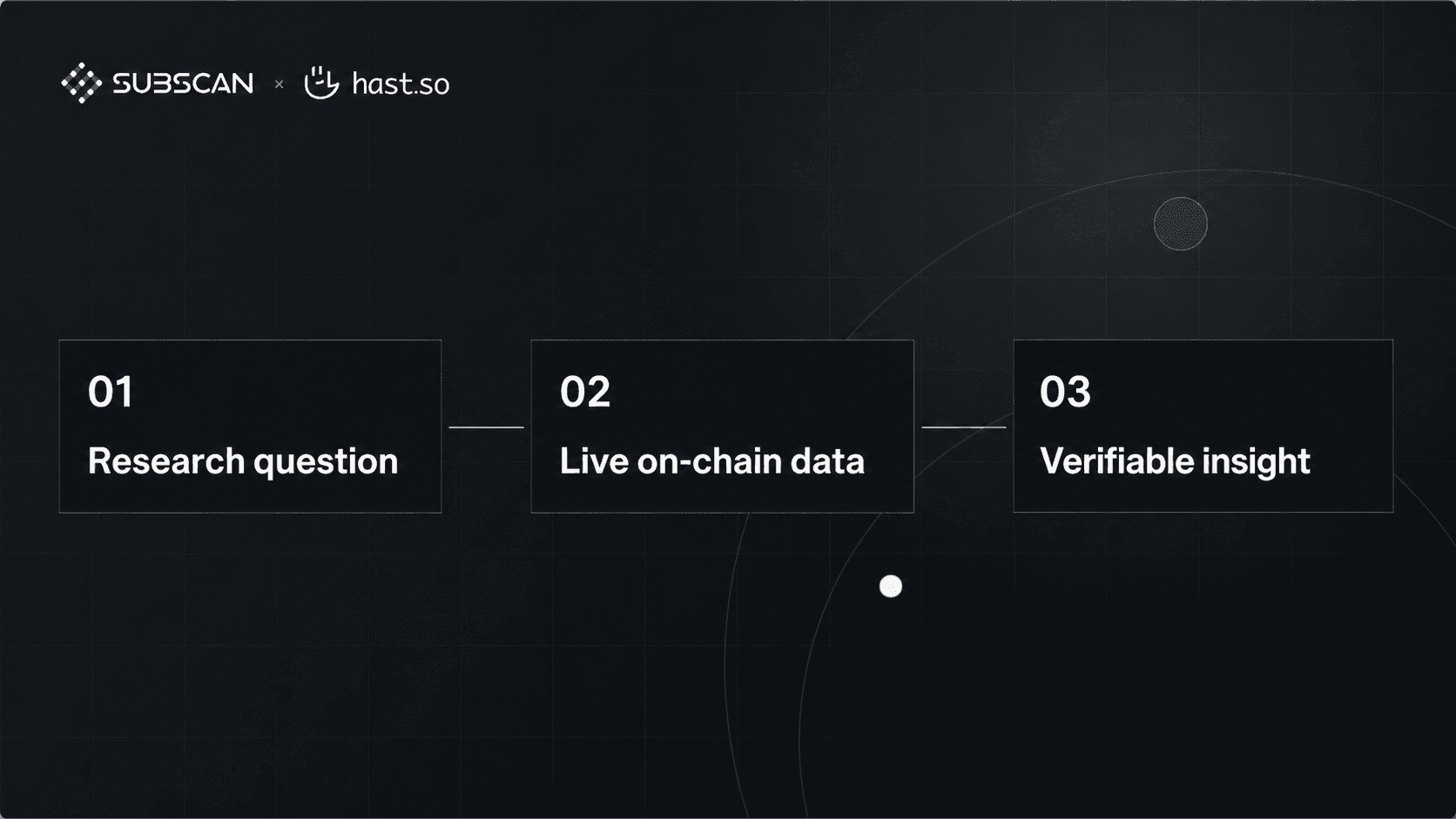
From on-chain queries to deep research
Subscan is one of the Substrate ecosystem's most established multi-chain block explorers and data infrastructure providers. Over the years, Subscan has transformed fragmented, complex on-chain records into a clear, stable, and verifiable data experience spanning transactions, accounts, governance, staking, validators, assets, and cross-chain activity. Its API covers more than 90 Substrate-based networks, providing a reliable data foundation for users verifying on-chain activity, developers building products, and researchers analyzing network behavior. Subscan is not only a tool for querying on-chain records; it is an important link between raw on-chain data and real-world decisions.
Looking up one transaction normally takes a hash. Understanding a pattern of on-chain behavior requires a very different way of working.
When someone wants to know which accounts were most active during a period, where funds ultimately moved, or how governance participation changed on a network, they must define the scope, choose several endpoints, handle paginated data, run calculations, and turn the result into a conclusion people can understand.
Subscan saw a new opportunity: let people begin by describing the question they want to research instead of searching for the right pages, fields, and APIs.
Subscan has long answered “where is the on-chain data?” Deep Research aims to go further and answer “what does this data mean?” We did not want to add another chat box. We wanted complex on-chain research to actually run.
Making on-chain research run
Subscan and Hast started with a real question:
Summarize governance participation on Kusama in 2025 and identify the most active voters.
The task requires organizing referendum states, identifying participating accounts, counting voting activity, and analyzing aye, nay, abstain, on-chain identity, and delegation relationships.
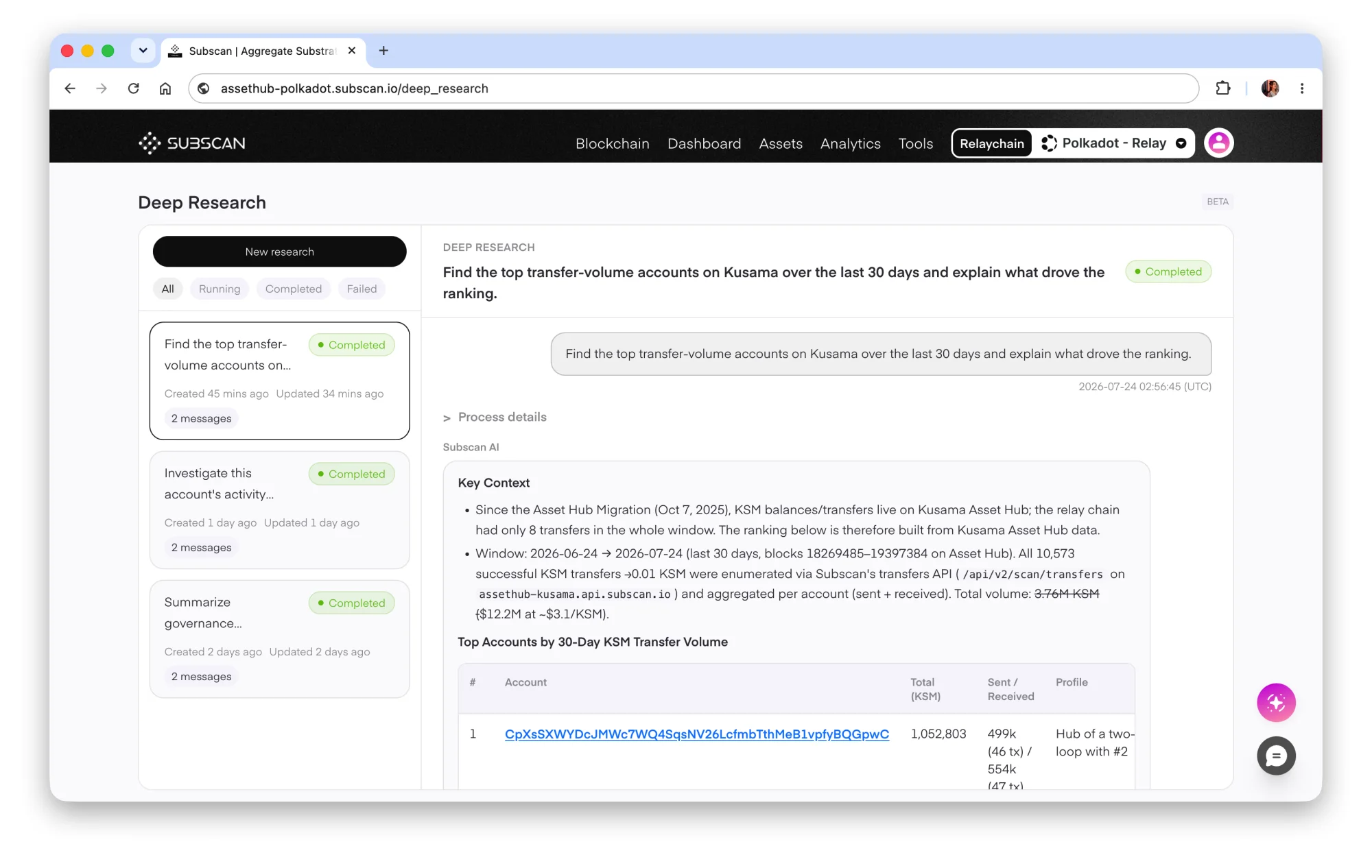
In Subscan Deep Research, a user only needs to describe the research goal. The system establishes the data scope, calls live Subscan data, performs the required aggregation and calculations, and returns a structured conclusion.
In the current demonstration, the research completes in about six minutes. The result includes a governance overview, a ranking of active voters, and important behavioral patterns, while retaining context for follow-up questions.
The same approach can support research into:
- Governance participation and voting behavior
- Staking returns and validator performance
- Account activity and movement of funds
- Cross-chain activity and anomalous transactions
From prototype to complete workflow
A chat interface is not the same thing as a research product.
Complex research can run for several minutes or longer. People need to see status and progress, return after leaving the page, recover from temporary failures, preserve research context, and receive structured HTML, CSV, or JSON artifacts.
In the collaboration, Subscan retains its brand, front-end experience, on-chain data, and APIs. Hast provides the planning, execution, and delivery capabilities behind each research job, with FDE engineering support to integrate them into the Subscan product.
The teams iterate around real research questions:
- Validate the research capability with governance, staking, and account-activity questions.
- Connect Subscan APIs and domain knowledge to the agent.
- Turn complex analysis into durable background jobs.
- Add progress, history, result artifacts, and follow-up questions.
- Keep the research process visible without exposing internal credentials.
This lets Subscan focus engineering effort on what differentiates the product: trusted multi-chain data, research methodology, and user experience—not rebuilding a complete agent runtime from the ground up.
Research that supports follow-up
Subscan Deep Research is currently available in beta.
After submitting a job, users can follow it from queued to running to completed. Research continues in the background when they leave the page and remains available in their history.
Once the research is complete, users can continue from the same result. After ranking active voters, for example, they can ask:
- Which accounts have a public on-chain identity?
- Which accounts show similar voting patterns?
- How do delegated accounts differ from direct voters?
- How does the ranking change for a specific governance track?
Each follow-up carries forward the existing context, allowing one answer to grow into a complete investigation.
Less infrastructure, more product differentiation
Based on the current product scope, independently building agent execution, asynchronous jobs, durable state, multi-turn context, failure recovery, progress visibility, and artifact delivery would require an estimated 32 engineer-weeks.
With Hast, Subscan-specific work can concentrate on domain data, product adaptation, front-end experience, and launch validation—an estimated four engineer-weeks.
That represents an estimated 87.5% reduction in initial engineering effort and approximately $70,000 to $90,000 in duplicate development cost avoided. These figures still need to be validated against actual development and maintenance data after production launch.
Engineering effort and cost figures are model-based estimates for the current scope, not audited Subscan financial results. They exclude Hast fees, model usage, and Subscan-owned front-end development.
More importantly, Subscan gains more than a faster first release.
Deep Research moves Subscan from helping people “find on-chain data” toward helping them “complete on-chain research.” Hast does not replace Subscan's data capabilities; it lets that data be understood, used, and delivered in a new product form.
Moving into the next phase
Subscan can extend Deep Research to more networks, data types, and research scenarios while turning valuable recurring questions into reusable research methods.
In the future, understanding a chain, a group of accounts, or a cross-chain event may no longer begin with finding the correct page or endpoint. It may begin by describing the research goal.
For Subscan, conversational on-chain research is not a replacement for the block explorer. It is the next layer of experience built on trusted multi-chain data.